Tool
Roofing contract template
Where the permit line belongs.
Updated 2026-10-18 · 7 min read
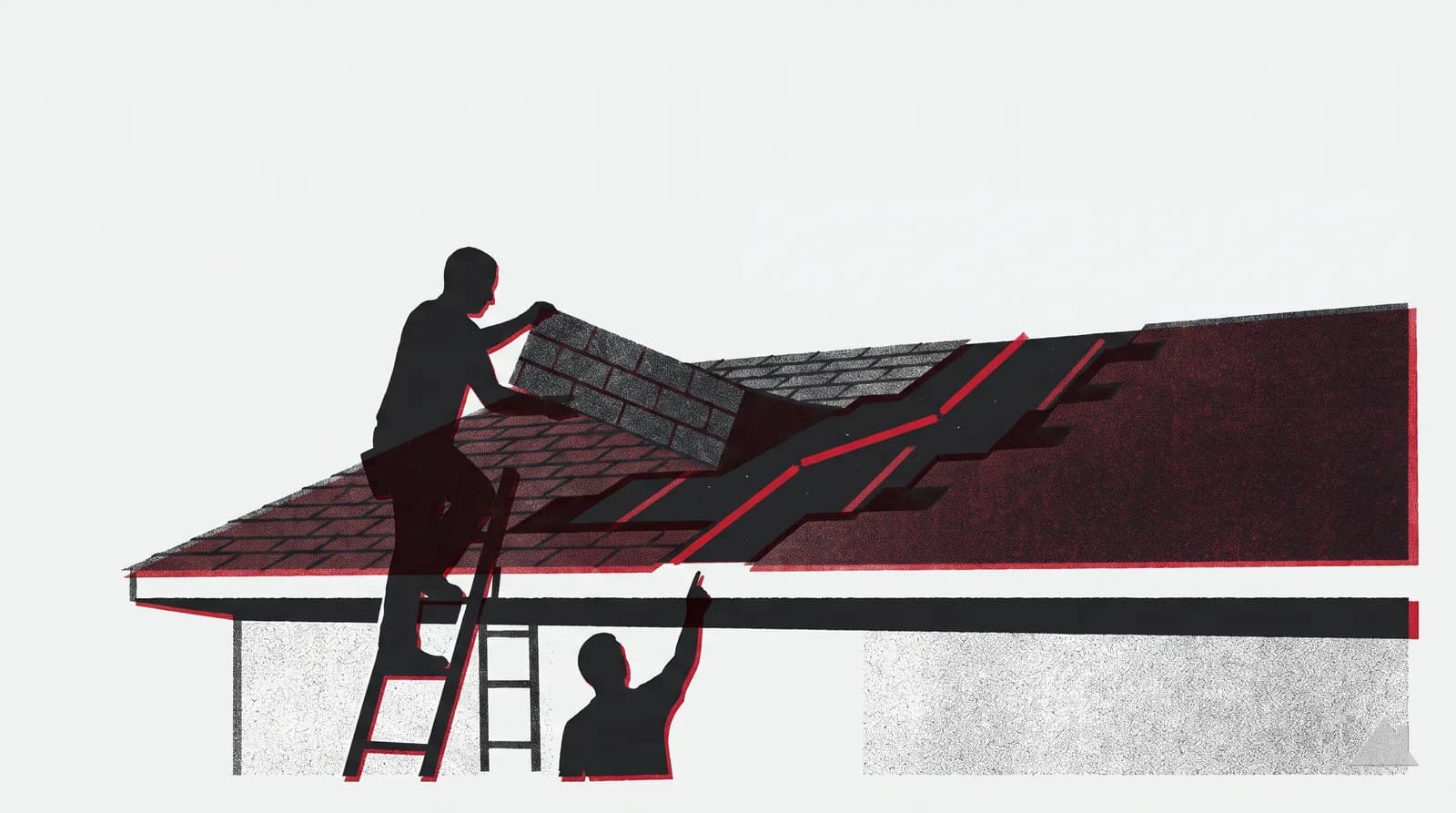
Almost everywhere, a full re-roof needs one. The common thresholds are a replacement of more than a set share of the roof area — the threshold varies by jurisdiction — any change of covering type, any structural work, and any work involving the deck. Small repairs under the threshold usually do not. Every one of those numbers is set locally, so the only correct first step is a phone call to your building department with the address.
The inspector is looking at a short list. Slope against covering: asphalt shingles are permitted down to 2:12, and between 2:12 and 4:12 the code requires double underlayment. Fastening: at least 4 per strip shingle, 12-gauge (0.105 in) shank, 3/8 in head, penetrating the sheathing by 0.75 inch. Drip edge: extending 1/4 inch below the sheathing, back 2 inches onto the roof, laps of 2 inches. And the ice barrier where the climate calls for it, running at least 24 inches inside the exterior wall line.
The layer limit is the one that stops a job
The IBC does not allow a recover over a roof that already has 2 or more layers (§1512.2.1.1), so a third layer is out, and an overlay on a roof that already has two will fail inspection with the new material already on it. Count the layers at the rake before you price anything — the replacement cost guide covers what a second tear-off layer adds.
Typically two. A dry-in or sheathing inspection after tear-off, with the deck exposed and the underlayment and ice barrier in place — this is the one that actually protects the homeowner, because it is the only time anyone official sees the deck. Then a final after the covering, flashing and ventilation are complete.
Schedule the dry-in inspection into the programme rather than around it. A crew that covers the deck before it is inspected will be asked to open it, and that is a day nobody priced.
The contractor should. A licensed contractor pulling the permit in their own name puts responsibility for code compliance on them; a homeowner pulling it as an “owner-builder” to save a fee moves that responsibility — and the liability for anything the inspector misses — onto the homeowner. If a contractor asks you to pull the permit, ask why, and check whether they are licensed in your jurisdiction at all.
Put the permit in the contract as a named line: who applies, who pays the fee, and which inspections are scheduled. Unpermitted roof work also surfaces at sale, when a buyer’s inspector finds a roof with no record.
Where the permit line belongs.
What the dry-in inspection is looking at.
One of the details on the inspector's list.
When the code allows a second layer, and what skipping the tear-off defers.