Guide
Roof pitch chart
Every pitch from 1/12 to 12/12 with its angle, multiplier and walkability.
Pitch is the only number that turns a footprint into a roof. A 1,700 sq ft house plan is not 1,700 sq ft of roof — at 6/12 it is 1901 sq ft, and you buy shingles against the bigger number. Enter rise and run below and the calculator gives you the pitch, the roof angle, the multiplier and the corrected square count.
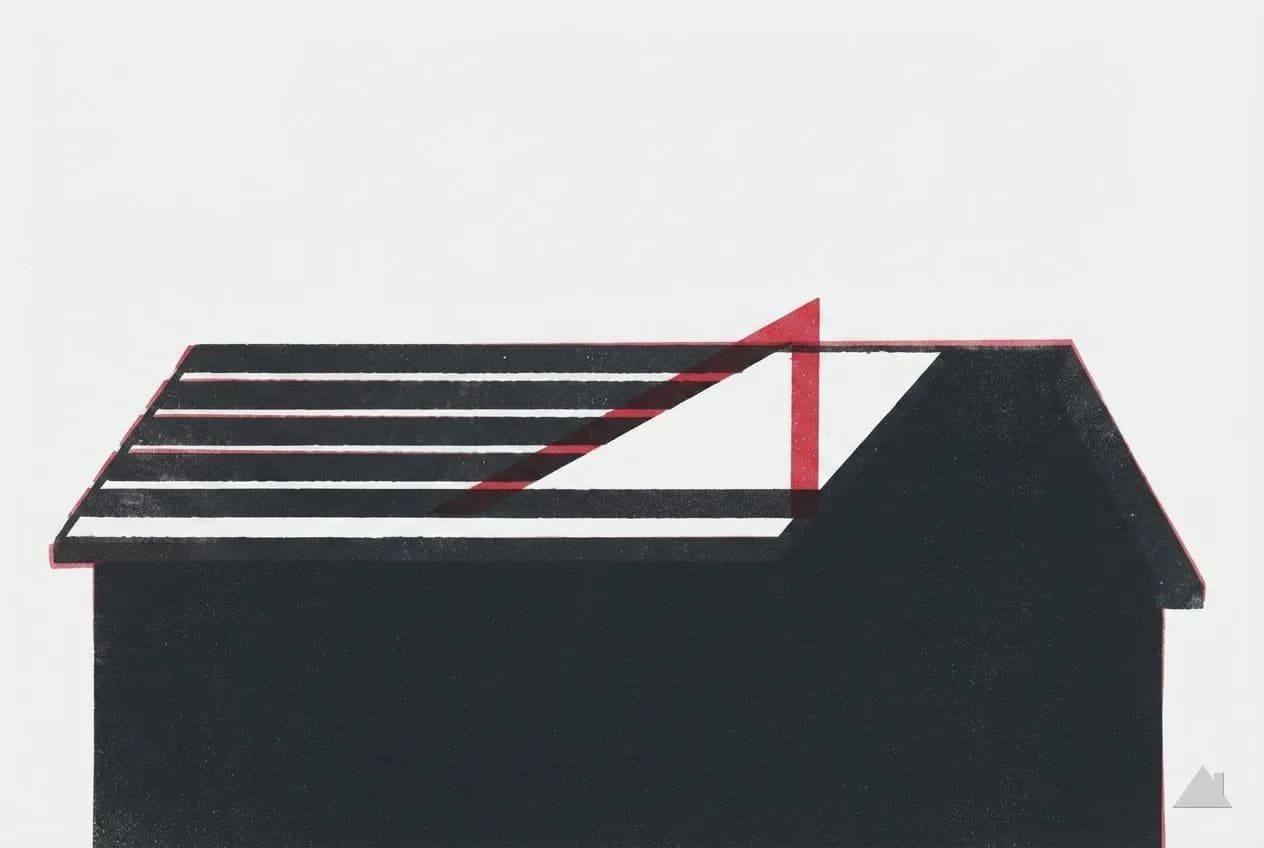
Measure 12 inches horizontally from any point on the rafter, then measure straight down to the roof. That drop is the rise. Pre-filled with a 6/12 on a 1,700 sq ft plan.
6/12
26.6° · multiplier 1.118 · Walkable — boots only
| Line | Value |
|---|---|
| Plan (footprint) area | 1,700 sq ft |
| Slope multiplier | × 1.118 |
| True roof surface | 1,901 sq ft |
| Squares to order against | 19.0 sq |
The rafter is the hypotenuse of a right triangle whose base is 12 and whose height is the rise. So the multiplier is √(1 + (rise/12)²) — nothing is looked up, it is computed. At 4/12 that is 1.054, at 8/12 1.202, at 12/12 exactly 1.414 (√2). Multiply the footprint by it and you have the surface you are covering. Turn that into squares on the roof square calculator, then into bundles on the shingle bundle calculator.
Above 6/12 a crew stops walking and starts staging. Roof jacks and planks go on, material gets carried instead of slid, and production per man-hour falls. That shows up twice in a bid: more squares from the multiplier, and a higher labour rate per square. The labour-per-square guide has the production numbers; the pitch chart is the printable version of the table above.
From inside the attic, hold a level against a rafter, mark 12 inches along it, and measure straight down from that mark to the rafter. That drop is the rise. From the ground, a photograph of the gable end taken square-on gives the same triangle: measure the rise and the half-span off the photo and scale them. Both beat guessing — a 6/12 called as a 4/12 under-orders by 6.1%.
Every pitch from 1/12 to 12/12 with its angle, multiplier and walkability.
Plan dimensions and pitch to true roof area for gable, hip and shed shapes.
The trade's only unit, and how squares become bundles and dollars.
Run, pitch and overhang to rafter length, plumb and seat cuts.
Below 2:12, the membrane decision.